- EN

 Log in
-
- Live Auctions
- Online Only
- Past auctions
- Kornfeld today
- The Story of Kornfeld
- Information
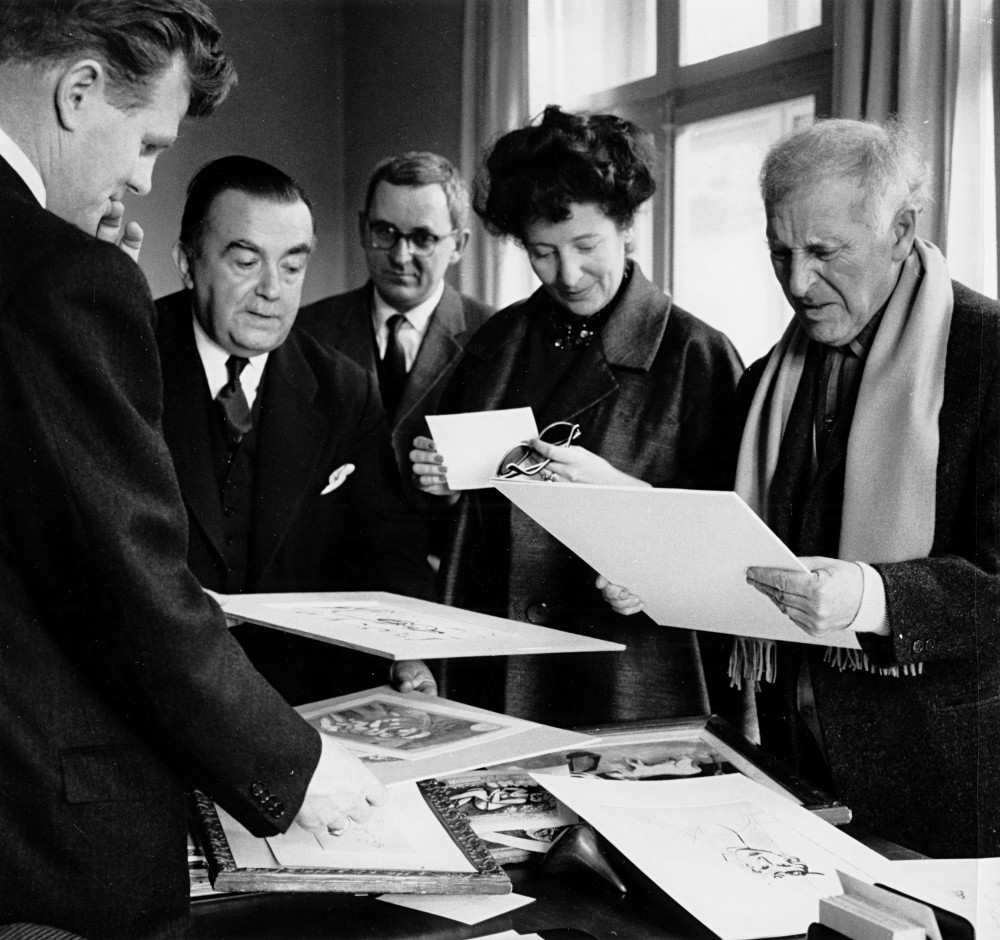
Eberhard W. Kornfeld was not only an art dealer. He also passionately collected art, and he did so with encyclopaedic ambitions. During his lifetime, he amassed one of the most significant private European collections of modern and classical art, with a unique focus on works on paper.
In January 1945, Kornfeld began training with the Bern-based art dealer Dr August Klipstein. The company was renowned for its expertise in works on paper, which was recognised far beyond Switzerland’s borders. During the summer months, Kornfeld regularly visited print rooms in Basel, Paris, London and Amsterdam to educate himself autodidactically. Following Klipstein’s unexpected death in April 1951, Frieda Schuh and Eberhard Kornfeld took over the company, together with the Klipstein family. A few years later, Kornfeld became the sole managing director and gradually acquired a majority stake in the company. From 1972 onwards, he ran it as a limited partnership under his own name. For many decades, Kornfeld virtually wrote hundreds of auction catalogues singlehandedly. During this time, countless works of art passed through his hands; there were probably few art dealers who held nearly as many works in their hands as Kornfeld did. His impressive and in-depth expertise made him an internationally respected ‘scholar dealer’ – a dealer who was considered a walking art encyclopaedia, while practising his profession with the utmost connoisseurship. It was with this very connoisseurship that he also assembled his own collection.
Drawings and prints formed the core of Kornfeld’s collection. As an art dealer and publisher, he soon developed a keen sense of the significance of prints. For centuries, artists had used prints to reproduce and share their work with a wide audience. Kornfeld, however, opined that graphic works were more than mere accompaniments to painting and sculpture. He considered them to be art forms in their own right that conveyed thoughts, experiments and the artist’s style more immediately and personally than monumental individual works. In fact, prints had already become an experimental field by the 19th century. Etchings, lithographs and woodcuts had long ceased to be mere reproductions, developing into independent forms of expression.
Illustrated books and print series edited in portfolios were an important part of his collection. It was precisely in these that he recognised an authentic expression of artistic thought, as the artist’s book combines image, text and materiality into a unified work of art – a Gesamtkunstwerk – thus visualising the creative process. He was particularly fascinated by the interplay between artists, printers and publishers, viewing the production of a graphic series as a creative dialogue in which technical precision and artistic vision converge.
Kornfeld was also interested in artist’s books, because they offer a particularly personal way of engaging with a work of art. Unlike paintings or drawings on a wall, books are picked up and experienced in a temporal sequence as they are leafed through. Viewers are actively guided through visual sequences, texts, rhythms and dramatic transitions. Kornfeld appreciated this very intimate encounter with art because it aligned with his view of collecting as a form of mental exploration. Furthermore, Kornfeld had a pronounced awareness of history. For him, artist’s books and print portfolios were important records of European art history. Many 20th-century avant-garde movements, ranging from Expressionism to Surrealism, disseminated their ideas through portfolios, illustrated books and prints. Collecting these artefacts preserved not only individual works, but entire artistic thought processes and cultural networks.
Kornfeld’s passion for artist’s books and print series was ultimately based on the conviction that art does not exhaust itself in one unique masterpiece. He believed that the spiritual depth of an artist was revealed with particular intensity in printed, serial and often rather quiet works. Such works demonstrate experimentation, reflection and collaboration – that vibrant dimension of art which fascinated Kornfeld all his life.
The lithographic series ‘Elles’ by Henri de Toulouse-Lautrec is unquestionably one of the highlights of this catalogue. Edited by the legendary Paris art dealer and publisher Gustave Pellet in 1896, this portfolio ranks among the masterpieces of 19th-century printmaking. Kornfeld was also close friends with Maud and Maurice Exsteens. Maud was Pellet’s only daughter and heiress, and she often told Kornfeld that, as a child, she used to sit on Henri de Toulouse-Lautrec’s knee. Alongside ‘Elles’, Kornfeld acquired other significant 19th-century portfolios, including Paul Gauguin’s ‘Dessins lithographiques – Suite Volpini’, Pierre Bonnard’s ‘Quelques aspects de la vie de Paris’ and William Blake’s renowned ‘Illustrations of the Book of Job’.
Kornfeld’s collection also gave a prominent place to the Brücke artist group, the Bauhaus and Dadaism. Over many years, he brought together key publications and writings by these movements. As well as official printed works such as the Brücke portfolios and Bauhaus prints, he also collected illustrated books and portfolios by Max Ernst, Lyonel Feininger, Wassily Kandinsky, Ernst Ludwig Kirchner, Paul Klee, László Moholy-Nagy and Kurt Schwitters.
As Kornfeld was friends with many artists and a passionate collector, he regularly acquired illustrated books from his immediate circle of artist friends. This is why his collection also contains numerous works by Marc Chagall and Alberto Giacometti, as well as by artists such as Le Corbusier, Joan Miró or Pablo Picasso. One of Kornfeld’s key contacts was the Greek-born publisher Stratis Eleftheriadis, known as Tériade. Based in Paris, he collaborated with ‘Cahiers d’Art’, founded by Christian Zervos, from 1926 onwards. In 1933, Tériade and Albert Skira founded ‘Minotaure’, a journal associated with the Surrealists. With his sumptously designed art journal ‘Verve’, which ran from 1937 to 1960, Tériade finally created one of the most significant platforms for contemporary art. From 1943 onwards, he also began publishing important artist’s books, reaching a first culmination in 1947 with Henri Matisse’s famous artist’s book ‘Jazz’ (see catalogue 291). He also worked with Marc Chagall, publishing, amongst other works, Jean de La Fontaine’s ‘Fables’, lavishly illustrated with original prints, ‘La Bible’, and, later, the colourful portfolio ‘Cirque’.
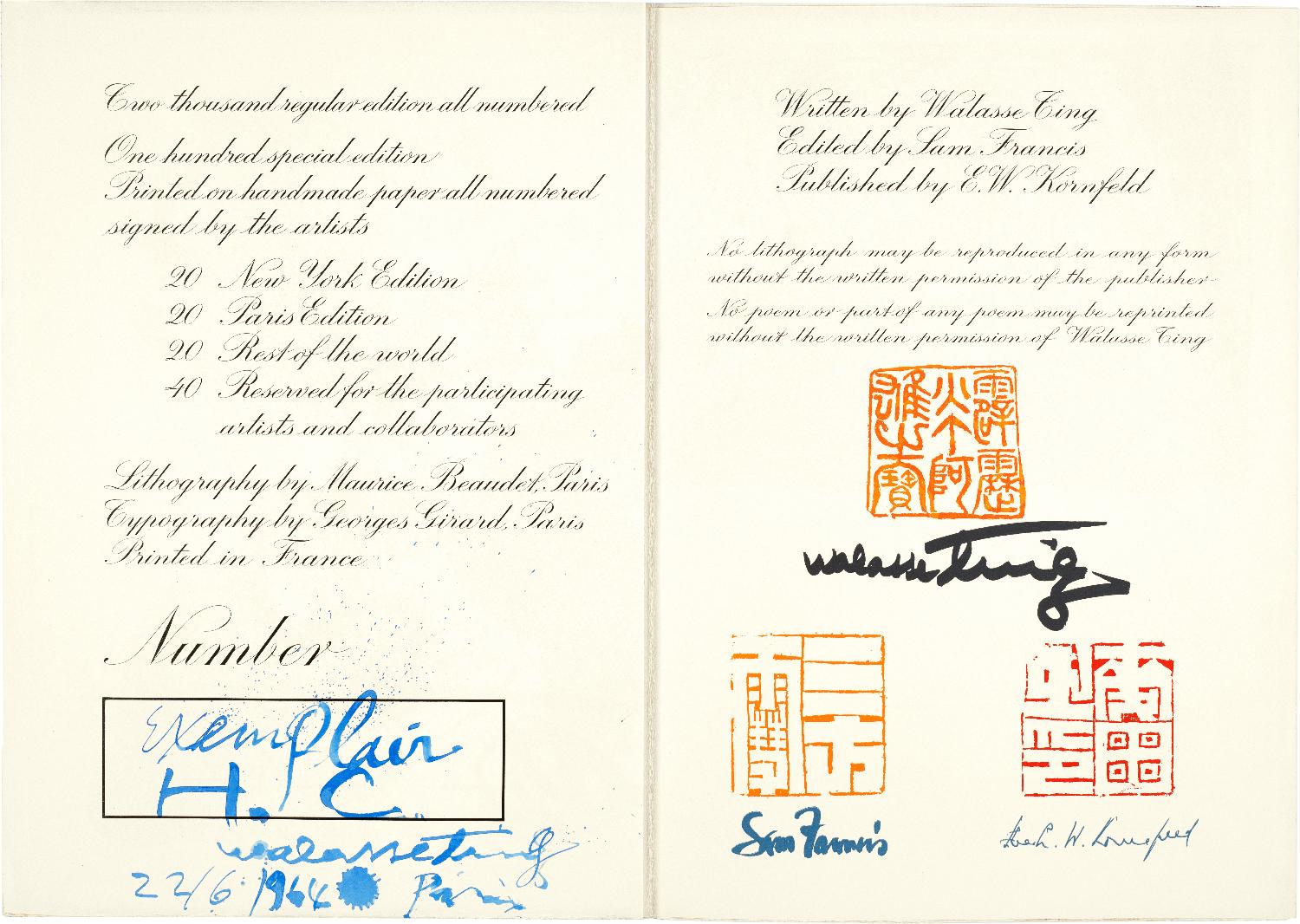
Non only was Kornfeld a collector, he was also a committed publisher of prints. He regularly published special editions of his exhibition catalogues, featuring signed and numbered prints. His most important publishing achievement was undoubtedly the artist’s book ‘1 Cent Life’. Today, it is considered one of the major works of American post-war and Pop Art printmaking. At the beginning of the 1960s, Kornfeld was approached by the artist Walasse Ting, whom he had met in Sam Francis’ studio at 940 Broadway in New York. Ting proposed an ambitious project: the publication of a book of his own poems, illustrated by leading Pop Art, Tachism and Neo-Dadaism artists. Ting spent two years working on this project, convincing artists such as Pierre Alechinsky, Jim Dine, Sam Francis, Robert Indiana, Roy Lichtenstein, Joan Mitchell, Claes Oldenburg, Mel Ramos, Robert Rauschenberg, James Rosenquist, Tom Wesselmann and Andy Warhol to participate. The first copies were presented at the ‘Illustrated Books’ exhibition at the Museum of Modern Art in New York in the autumn of 1964. The New York Times wrote enthusiastically that ‘… best of all in this line is Ting’s hilarious circle of poems illustrated by so many important artists.’
During his lifetime, Ebi Kornfeld donated a few key pieces from his collection to museums. However, he did not want the vast majority of his collection to disappear into museum storerooms. It was his express wish that his collection, which had been built up over more than 70 years, should be added to other collections after his death. The works were to continue to be enjoyed to by people who love and appreciate art just as much as he had done during his lifetime. We would like to thank the Kornfeld family for placing their trust in our company, which we are honoured to be able to carry forward into the future in Ebi’s spirit.
Online Kataloge